Australian Labradoodle Education

Why Australian Labradoodles Are Considered High-Quality Companion Dogs
When families search for an Australian Labradoodle, they’re often looking for more than a cute puppy — they’re looking for reliability, temperament stability, and long-term health. The Australian Labradoodle is widely considered a high-quality companion breed because it was intentionally developed through multigenerational breeding with a focus on structure, health, and temperament predictability.
Unlike first-generation Labradoodle crosses, the Australian Labradoodle has been carefully refined over decades to create consistency in coat type, size, and personality. When bred responsibly, this results in a dog that is both affectionate and stable, intelligent yet adaptable.
What Makes Australian Labradoodles Different from Other Labradoodles?
One of the most important distinctions is that Australian Labradoodles are multigenerational. Rather than being a simple Labrador Retriever and Poodle mix, they are developed from established lines that may include Labrador Retriever, Poodle, and select spaniel influence several generations back.
Multigenerational breeding allows ethical breeders to:
Stabilize coat consistency (fleece or wool, low-shedding)
Improve structural soundness
Track health history across generations
Select for balanced, family-friendly temperament
This generational refinement is a major reason why Australian Labradoodles are considered more predictable than first-generation doodles.
Temperament: Designed for Family Life
Australian Labradoodles were originally developed as allergy-friendly assistance dogs. As a result, temperament has always been central to the breed’s purpose.

Well-bred Australian Labradoodles are typically:
Social and people-focused
Intelligent and eager to learn
Emotionally intuitive
Adaptable to active or moderate lifestyles
Because temperament is intentionally selected over generations — not left to chance — families often experience a dog that combines playfulness with calm companionship.
Are Australian Labradoodles Hypoallergenic?
No dog is 100% hypoallergenic. However, many Australian Labradoodles have low-shedding coats that are more tolerable for individuals with mild to moderate allergies.
Responsible breeders prioritize:
Coat texture consistency
Reduced shedding traits
Healthy skin and coat genetics
The predictability of coat type is one of the benefits of multigenerational breeding programs.
Health Testing and Genetic Responsibility
High-quality Australian Labradoodles come from programs that emphasize comprehensive health testing and careful genetic planning.
Ethical breeders commonly perform:
OFA or PennHIP hip evaluations
Elbow certifications
Annual CAER eye exams by a veterinary ophthalmologist
DNA panel testing for breed-specific conditions
COI (Coefficient of Inbreeding) analysis
These evaluations help reduce hereditary risk and strengthen long-term health outcomes. Quality breeding is not accidental — it is intentional and measurable.
At Forever Friends Labradoodles, for example, health testing, structured early development, and genetic planning are foundational standards — not optional add-ons.
Click the link to learn more about our testing……https://foreverfriendslabradoodles.com/about/
Early Socialization Shapes Long-Term Quality
A puppy’s first eight weeks significantly influence its lifelong temperament.
Structured programs such as Puppy Culture and the Badass Breeder curriculum incorporate:
Early Neurological Stimulation (ENS)
Early Scent Introduction
Novel surface exposure
Gentle startle recovery exercises
Problem-solving enrichment
Crate introduction and grooming desensitization
These structured experiences build confidence, adaptability, and resilience — traits that families consistently value in a companion dog.
How We Socialize Our Australian Labradoodle Puppies
Bringing home a puppy is exciting, but a puppy’s early experiences shape the dog they will become. One of the most important things we focus on while raising our Australian Labradoodle puppies in Avon, Indiana is thoughtful, early socialization.
Our goal is simple: raise puppies that are confident, curious, and ready to adapt to family life.
From the time our puppies are born until they go home at 8 weeks old, they are gently introduced to new experiences, sounds, people, and environments. These early lessons help build a strong foundation for a happy, well-adjusted dog.
Why Early Puppy Socialization Matters
The critical learning window for puppies
Puppies go through an important learning period during their first few weeks of life. During this time, their brains are especially open to new experiences.
Positive exposure to everyday sights, sounds, people, and environments helps puppies grow into calm and confident adult dogs.
Without early exposure, new experiences later in life can feel overwhelming or scary.
How early experiences shape temperament
Early socialization helps puppies learn that the world is a safe place. When puppies experience new things in a gentle and positive way, they develop important life skills like:
Confidence
Curiosity
Adaptability
Problem solving
Trust in people
These traits make it easier for puppies to transition into their new homes.
Our Socialization Approach
Raised in our home, not a kennel
Our puppies are raised in our home, where they are part of daily life. This allows them to naturally experience the sights and sounds of a normal household.
They see people moving around, hear everyday noises, and learn that these things are normal.
Being raised in a home environment helps our puppies feel comfortable when they move into their new families.
A blend of Puppy Culture, Badass Breeder, and Early Neurological Stimulation
We use a thoughtful combination of proven puppy development programs including:
Puppy Culture
Badass Breeder
Early Neurological Stimulation (ENS)
These programs help us introduce experiences at the right pace for growing puppies while supporting healthy brain development, resilience, and confidence.
Experiences Our Puppies Have Before Going Home
Before leaving for their new homes, our puppies experience a wide variety of people and situations.
Meeting different people and children
Our puppies are exposed to different types of people, including children. This helps them learn that people of all ages are safe and friendly.
Exposure to other dogs
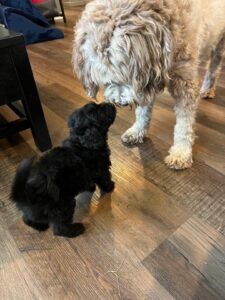 Puppies interact with other dogs so they begin learning normal canine communication and social skills.
Trips outside our home

We also take our puppies to new places outside our home so they can safely experience different environments.
These outings help puppies build confidence as they explore the world around them.
Confidence Building Through New Environments
Exploring different surfaces
Puppies learn by exploring, so we provide opportunities to walk on different textures and surfaces such as:
Tile floors
Wood floors
Carpet
Wobble boards
Ramps
Tunnels
These experiences help develop coordination, body awareness, and confidence.
Problem solving and curiosity
Activities like ramps and tunnels encourage puppies to think, explore, and solve small challenges. This helps build curiosity and resilience.
Sound Desensitization
Many dogs become nervous around unfamiliar noises. That is why we gently introduce our puppies to common household sounds.
Household noises puppies experience
Our puppies are exposed to everyday sounds such as:
Vacuum cleaners
Hair dryers
Washing machines
Dryers
Doorbells
Pots and pans
Environmental sounds
We also introduce sounds like:
Rain
Fireworks
These sounds are introduced carefully and gradually so puppies learn that they are normal parts of life.
Early Training We Start With Our Puppies
While puppies are still young, we begin introducing simple skills that make the transition to a new home easier.
Crate introduction
 Puppies begin learning that a crate can be a safe and comfortable place.
Early potty training
We introduce the basics of potty training to help puppies begin developing good habits.
Recall beginnings
Puppies are gently encouraged to come when called, which helps build the early foundation for recall.
Leash introduction
We begin exposing puppies to the feeling of a leash so it is not completely new once they go home.
Sit to say please
Puppies are introduced to the idea that calm behavior earns attention and rewards.
Why Socialization Makes the Transition Home Easier
Confident puppies adjust faster
When puppies have experienced new environments, people, sounds, and gentle training, they often adapt more easily to their new homes.
They are already familiar with many everyday experiences.
A strong foundation for families
Our goal is to give each puppy the best possible start so families can continue building on that foundation.
When a puppy has already experienced thoughtful early socialization, new owners can focus on continuing training and strengthening the bond with their dog.
Raising Confident Australian Labradoodle Puppies
Raising puppies is something we take seriously. Every experience we provide is meant to help our puppies grow into confident, loving companions.
If you are looking for a thoughtfully raised Australian Labradoodle puppy in Avon, Indiana, we would love to connect with you.
Ready to Learn More?
Visit our Available Puppies page
Learn about our Puppy Adoption Process
We are always happy to talk with families who want to give one of our puppies a loving home.
Versatility and Lifestyle Compatibility
Another reason Australian Labradoodles are highly regarded is their versatility. When responsibly bred and properly socialized, they thrive in:
Active family homes
Households with children
Therapy or service roles
Companion settings for retirees
Suburban or rural environments
Their adaptability allows them to integrate smoothly into many lifestyles.
The Role of Responsible Breeding
It’s important to understand that breed quality depends heavily on breeder standards. Not all Labradoodles are raised with the same level of structure or oversight.
An ethical Australian Labradoodle breeder prioritizes:
Multigenerational lineage
Comprehensive health testing
Genetic diversity planning
Early structured socialization
Careful temperament matching
Lifetime breeder support
When these elements are present, Australian Labradoodles consistently demonstrate the qualities that have made them one of the most sought-after companion breeds in the United States.
Frequently Asked Questions About Australian Labradoodles
What is the difference between an Australian Labradoodle and a Labradoodle?
An Australian Labradoodle is multigenerational and selectively bred for consistency in coat, size, and temperament, while many Labradoodles are first-generation crosses.
Are Australian Labradoodles good family dogs?
Yes. When responsibly bred and properly socialized, they are known for their affectionate, adaptable, and people-oriented temperament.
Do Australian Labradoodles shed?
Many have low-shedding fleece or wool coats, though no dog is completely non-shedding.
How much health testing should a breeder perform?
Reputable breeders complete orthopedic evaluations (OFA or PennHIP), eye exams, genetic panels, and consider COI before pairing dogs.
Are Australian Labradoodles easy to train?
Their intelligence and eagerness to please typically make them highly trainable, especially when early enrichment and structure are provided.
Click this link for our FAQ page with even more answers to your questions…https://foreverfriendslabradoodles.com/frequently-asked-questions/
Final Thoughts
Australian Labradoodles are considered high-quality companion dogs because they were intentionally developed for health, temperament stability, and lifestyle adaptability. When bred responsibly through multigenerational programs that prioritize measurable standards, they offer a rare combination of emotional intelligence, trainability, and predictability.
Families seeking a thoughtfully bred companion should evaluate both the structure of the breed and the standards of the breeder behind the litter.
Australian Labradoodle Grooming
Shampoo & Detangler: What to Use (and Why It Matters)
Shampoo:
- Use a gentle, dog-specific shampoo
- Look for moisturizing formulas (not harsh or stripping)
- Avoid human shampoos—they disrupt skin pH
Conditioner/Detangler:
- Always follow with a conditioner or detangling spray
- Helps prevent knots and makes brushing easier
- Lightly mist before brushing to reduce breakage
👉 Brushing a completely dry coat can cause damage—light moisture helps protect the hair.
Dematting Combs: Use With Care
When to use:
- Small tangles or early mats
- Not for heavily matted coats
How to use:
- Hold the base of the hair near the skin (to prevent pulling)
- Gently work the tool through the mat
- Use short, controlled strokes—never force it
⚠ Important:
If the mat is tight to the skin, it’s often more humane to have it professionally shaved out. Pulling can cause pain and skin irritation.
Trimming Around the Face
Key areas to maintain:
- Around the eyes (to keep vision clear)
- Around the mouth (to prevent buildup and odor)
- Under the chin
Tips:
- Use blunt-tip grooming scissors
- Trim small amounts at a time
- Keep a natural, soft shape—avoid sharp or choppy cuts
The Distinctive Australian Labradoodle Groom


The Australian Labradoodle is known for its natural, balanced, “teddy bear” look.
This is not a tight poodle cut—it’s softer and more relaxed.
Key features:
- Plush, even coat (typically ½–1 inch long)
- Rounded face with expressive eyes
- No harsh lines or overly sculpted areas
- Natural movement and softness
At Forever Friends Labradoodles, we love a groom that enhances the dog’s natural beauty while keeping maintenance realistic for families.
Final Thoughts
Consistent grooming is one of the most important parts of caring for your Australian Labradoodle. A well-maintained coat prevents discomfort, supports healthy skin, and keeps your dog looking and feeling their best.
If you ever feel unsure, your groomer—and your breeder—are great resources. We’re always here to help guide you.

AVON, IN

Office: 317-490-8013
email: info@foreverfriendslabradoodles.com